
Apple Watch HRV accuracy: what the research shows
By Wellhero · Published · Updated
Apple Watch can record useful HRV data, especially when you are still. How closely a reading matches a reference device depends on the metric and the measurement conditions. Studies of controlled recordings do not establish the accuracy of every background reading.
The studies below explain why a watch can measure your pulse well and still produce an HRV value that differs from a chest strap or ECG. They also help separate a poor recording from a real change in your body.
What does Apple Watch actually measure?
The optical sensor detects the pulse at your wrist. HRV describes variation in the time between beats. An ECG records the heart's electrical activity, so the two methods obtain their timing from different signals. The Apple Watch validation studies discussed here concern optical measurements; they do not validate the watch's ECG app.
SDNN describes the spread of normal heartbeat intervals over a recording. RMSSD uses the differences between consecutive intervals. Both are expressed in milliseconds, but they are different calculations. Apple's SDNN documentation identifies the metric for that HealthKit data type. Check which metric your app displays before comparing numbers.
Recording length matters too. A brief reading and a five-minute recording do not summarize the same period. The 1996 HRV measurement standards emphasize consistent recording duration and conditions. For more on the calculations, see our HRV metrics guide.
How accurate is Apple Watch HRV in studies?
There is no single accuracy percentage that applies to every Apple Watch reading. These studies used different devices and protocols. None of them tested Wellhero's stress or recovery scores.
2018: good agreement for recorded heartbeat intervals
Hernando and colleagues studied 20 healthy volunteers during seated relaxation and a mild mental task, comparing Apple Watch with a Polar H7 chest strap. They found strong agreement for the recorded intervals. Missing segments affected frequency-domain measures more than the time-domain measures in their experiment. This supports use under the conditions tested, with attention to gaps in the signal. Read the 2018 study.
2024: differences remained during morning Breathe sessions
O'Grady and colleagues compared Series 9 and Ultra 2 with a Polar H10 and Kubios in 39 healthy adults. They collected 316 paired readings over a study period of up to 14 days. Participants recorded five-minute Breathe sessions while lying still after waking.
Apple Watch SDNN was lower by 8.31 ms on average. The mean absolute error was 20.46 ms, which describes the size of the differences regardless of direction. These were deliberately started morning measurements, not random background samples. The average difference is not a correction to add to your own readings. Read the 2024 study.
2025: pulse accuracy did not translate directly to HRV accuracy
Bonneval and colleagues recruited 78 healthy adults and compared Series 6 with a three-lead Biopac ECG in a laboratory. Recordings included rest, conversation and conditions before and after walking. Agreement was strongest at rest. Heart rate and average interval measurements agreed more closely than the variability measure, and some recordings were missing. The findings concern a supervised protocol using Breathe and do not establish accuracy throughout daily life. Read the 2025 study.
2026: Apple's study tested heart rate accuracy
Apple's September 2026 report compared Apple Watch Series 12 with six other wearables, using a Polar H10 chest strap as the reference. Of 1,460 people enrolled, 1,254 contributed to the final paired analysis. Apple reported lower mean absolute error (MAE) and root mean square error (RMSE) than each comparator for the overall workout and daily-living protocols.
This is a manufacturer-published study of heart rate, with errors expressed in beats per minute. Its introduction mentions Recovery HRV, but the report does not present validation results for SDNN, RMSSD or Recovery HRV. It adds evidence about Series 12's pulse measurement; it does not establish the accuracy of its HRV readings or resolve the HRV differences found in the earlier studies. Read Apple's 2026 Heart Rate Accuracy Study (PDF).
Our practical interpretation: keep a consistent measurement routine and inspect unusual readings before treating them as a change in recovery. Results from these watch models and protocols cannot establish performance for every later model or software update.
Automatic, Mindfulness and overnight HRV
Automatic readings have less controlled context
Apple Watch saves HRV samples automatically. Series 12 and Ultra 4 can measure HRV as often as every five minutes, though actual records can have gaps. This is sampling frequency, not a continuous HRV recording or a guarantee of accuracy. Our guide to Apple Watch HRV frequency explains model differences. In Wellhero, you see the readings available through Apple Health after syncing.
A sample after a bike ride and one taken while resting before breakfast describe different circumstances. That difference alone cannot tell you whether the sensor was wrong. Check when the measurement was taken before comparing it with your usual resting value.
Mindfulness lets you choose the time
For a manual reading in Wellhero, use Breathe in the Mindfulness app. Wellhero's instructions recommend two to three minutes, keeping still and breathing normally. Use the same routine each time. Deliberately changing your breathing changes the conditions of the measurement.
This makes the context easier to repeat, but it does not guarantee an error-free result. The 2024 study above found differences even during planned Breathe sessions. Follow the steps on our Apple Watch HRV app page to find and analyze a session.
Overnight HRV needs its own comparison
Wellhero can use HRV samples recorded during your tracked sleep period. Compare the same kind of overnight summary across nights. An average of the available sleep samples and a single morning reading summarize different recordings; they may differ without either being faulty.
Gaps in overnight data mean less information is available. Wearing a watch to bed does not guarantee an uninterrupted night of HRV measurements.
How to get more consistent Apple Watch HRV readings
- Check the fit. The sensor should stay in contact with the top of your wrist, with a band that is snug and comfortable.
- Keep your wrist still during a manual session. Apple identifies motion and low blood flow at the skin, including in cold conditions, as factors that can affect optical readings. See Apple's measurement guidance.
- For a resting comparison, use a similar time, position and session duration. Keep post-workout readings separate from that routine.
- Compare the same metric and source. A watch SDNN value and a chest-strap RMSSD value cannot be used as a direct accuracy check.
- Review measurement quality when a result looks unusual. If the recording was interrupted or you moved, repeat it once under your usual conditions. Repeating only until you get a higher value makes your history harder to interpret.
Consistent conditions make comparisons more meaningful. They cannot establish clinical accuracy for an individual reading. HRV and app scores should not be used to diagnose a condition.
Should you enable AFib History to get more HRV readings?
AFib History has a specific medical purpose. Apple requires a physician diagnosis of atrial fibrillation and says the feature is not intended for people under 22. Do not enable it simply as a way to collect more HRV samples. Read Apple's AFib History requirements.
Using Apple Watch HRV in Wellhero
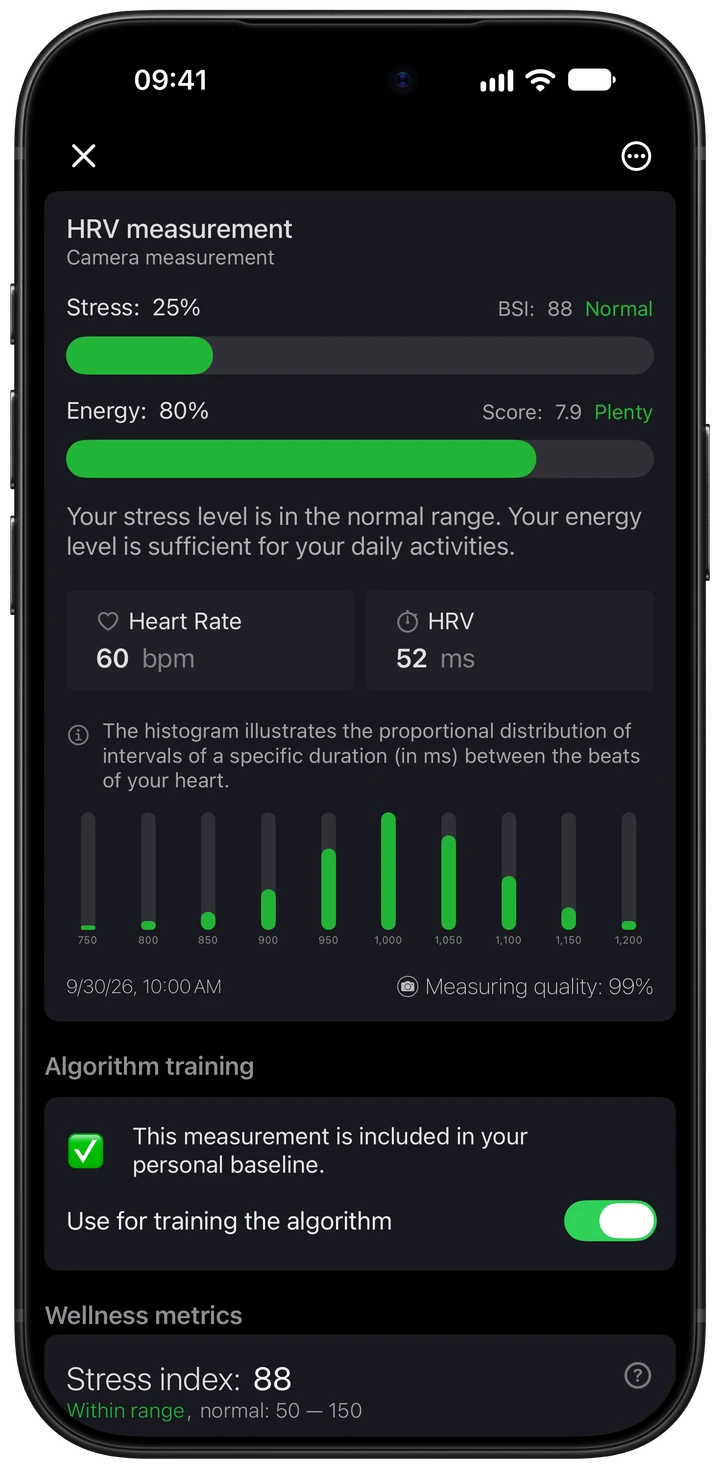
Wellhero brings your Apple Watch readings into your history and provides detailed reports for measurements with the data needed for analysis. Check the report's measurement quality as well as the HRV number. Processing cannot recover a heartbeat the sensor did not record.
Recovery HRV is the SDNN value Wellhero uses in its daily recovery assessment. It uses a morning measurement when available, otherwise the sleep average, then the day's average. That choice of source can help explain why Recovery HRV differs from another number in Apple Health.
See how recovery tracking works or how Wellhero estimates physiological stress. These interpretations are separate from the accuracy of the underlying measurement.
Common questions about Apple Watch HRV accuracy
Why is my Apple Watch HRV different from another app?
First check whether both apps show SDNN or RMSSD, then compare the time and source of the readings. Apps may select different samples or summarize different periods. A difference between two displayed numbers does not identify which is more accurate.
Does a low reading mean the watch is inaccurate?
A low value alone cannot establish a measurement error. Check the recording conditions and quality, and compare it with your own readings taken under similar conditions. One number cannot explain why your HRV changed.
Is a chest strap always more accurate?
The studies above used specific reference devices and processing methods. Their results do not validate every chest strap, watch or app. A useful comparison needs the same metric, simultaneous recordings and a documented reference method.
Review your Apple Watch readings
Use Wellhero to find a Mindfulness session, review its report and follow your measurement history. The Apple Watch setup guide explains the permissions and syncing steps.
Download Wellhero on the App StoreRelated reading: Why HRV changes throughout the day · Measure HRV with your iPhone camera