
MxDMn Explained: What Your HRV Range Means
By Wellhero · Published
MxDMn is the difference between the longest and shortest accepted heartbeat intervals in a recording. Wellhero shows it in milliseconds. If those intervals are 1100 ms and 820 ms, your MxDMn is 280 ms.
The number describes the full range of interval lengths. To interpret a change, look at the recording conditions and the other values in your HRV report.
How MxDMn is calculated
The name combines maximum, delta (difference), and minimum. You may also see this measure called the variation range or variation scope. The Kubios guide to HRV analysis defines MxDMn as the difference between the longest and shortest RR intervals.
An RR interval is the time between successive R peaks on an ECG. Optical measurements estimate the intervals between pulses. An HRV calculation uses the usable interval series after the measurement's quality checks.
MxDMn = longest interval − shortest interval
For example, take these ten interval lengths, in milliseconds: 940, 900, 820, 980, 1040, 1100, 1000, 960, 920 and 880. The shortest is 820 ms; the longest is 1100 ms. Subtracting them gives 280 ms.
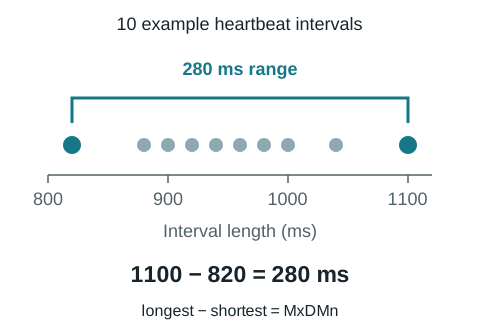
Keep the units attached to the number. An MxDMn of 280 ms is 0.28 seconds. It is a time difference, not a percentage or a difference in beats per minute.
What high and low MxDMn values mean
A higher value means a wider range
The longest and shortest accepted intervals are farther apart. But the same wide range can occur when intervals are spread throughout it or when most are close together and one sits far away. MxDMn alone does not distinguish these patterns.
A high reading therefore cannot confirm good recovery. Check the rest of the report and the recording conditions before interpreting the number.
A lower value means a narrower range
The interval lengths occupy a smaller span. This can help explain a higher Baevsky Stress Index, because MxDMn appears in its denominator. It does not identify the cause of the change or measure how anxious you feel.
Compare the value with your own readings from similar sessions. A short seated measurement and a much longer recording give MxDMn different opportunities to capture extreme values.
Why one extreme interval can change MxDMn
In the example above, MxDMn is 280 ms. Now suppose an additional interval of 1600 ms enters the accepted series. The minimum stays at 820 ms, but the range becomes 1600 − 820 = 780 ms. The original ten intervals have not changed.
This sensitivity follows directly from the formula: only the minimum and maximum determine the result. An incorrectly detected beat can change an endpoint, which is one reason measurement quality matters. An unusually long interval is not automatically an error, so the number alone is not a reason to discard it.
Laborde and colleagues' HRV recommendations discuss recording quality and handling artifacts. For everyday tracking, check the app's quality indication and repeat a poor-quality measurement under steady conditions before drawing conclusions.
What is a normal MxDMn?
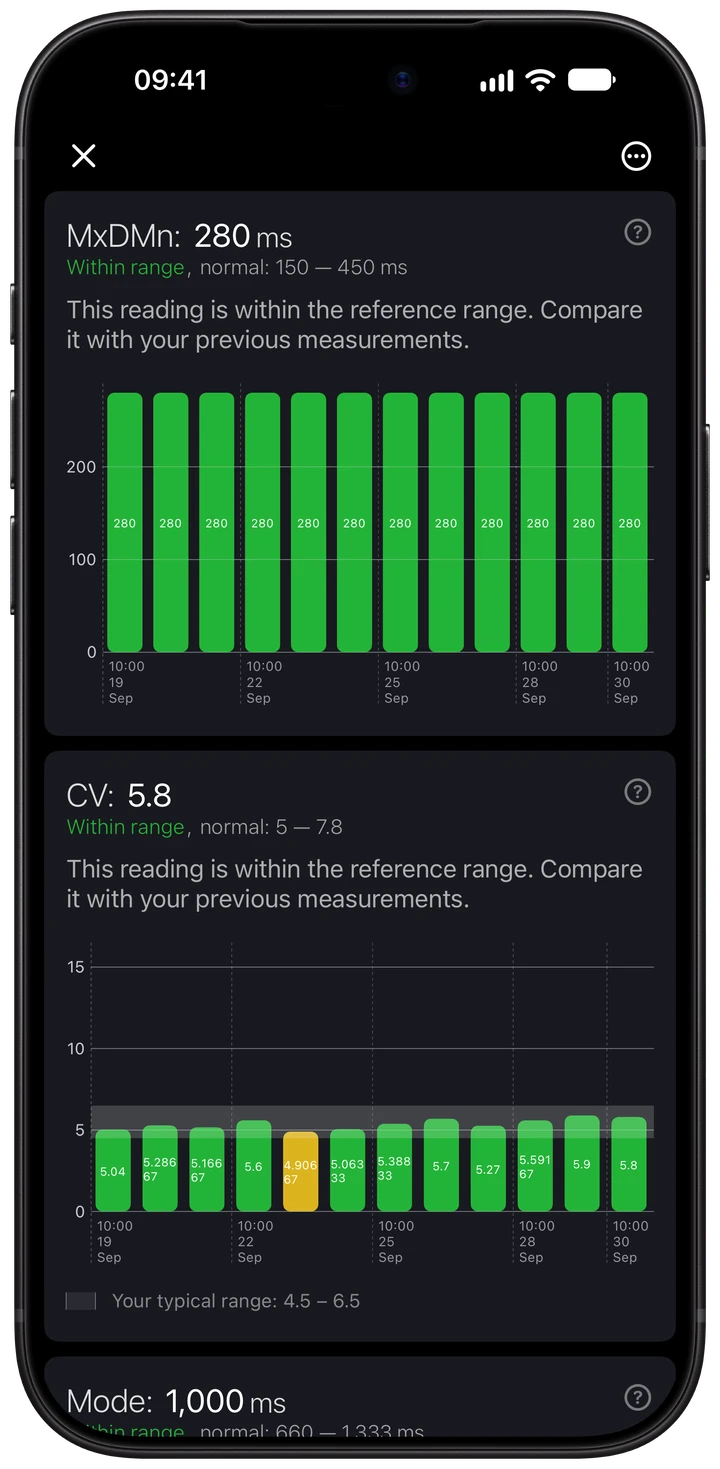
Wellhero currently uses 150 to 450 ms as the central reference band for this metric. The example card shows 280 ms within that band.
This range belongs to Wellhero's interpretation of MxDMn. It is not a universal clinical cutoff, and a result outside it does not diagnose a health condition. Your usual values and the conditions of the measurement provide additional context.
Open a measurement report and scroll to MxDMn to see its value and history. The Wellhero HRV app for iPhone shows this alongside other interval metrics, so you can compare more than the endpoints.
The app needs usable interval data to calculate MxDMn. A single HRV value from Apple Health, such as SDNN, does not contain the shortest and longest intervals needed to reconstruct it.
How MxDMn differs from AMo50
MxDMn describes the distance between the extremes. AMo50 describes how many intervals fit into the most populated 50 ms bin. Reading them together gives more information about the distribution.
| Metric | What the value describes |
|---|---|
| MxDMn | The longest interval minus the shortest, in milliseconds |
| AMo50 | The percentage of intervals in the busiest 50 ms bin |
A recording can have a wide range while most of its intervals sit in one bin. It can therefore have both a high MxDMn and a high AMo50. There is no fixed conversion between the two. Our AMo50 guide explains the bin calculation with a histogram.
Neither metric depends on the order of the intervals. RMSSD does: it uses the differences between consecutive intervals. The HRV metrics overview explains how these measures fit together.
MxDMn and Baevsky Stress Index
Wellhero calculates its Baevsky Stress Index using AMo50, the most frequent interval length (Mo), and MxDMn:
BSI = AMo50 ÷ (2 × Mo × MxDMn)
Our Baevsky Stress Index guide brings the inputs together in a worked example and explains how to interpret the result.
In this formula, AMo50 is entered as a percentage, while Mo and MxDMn are in seconds. The 280 ms range in our example would enter the denominator as 0.28.
If the other two inputs stay fixed, doubling MxDMn halves BSI. In real measurements, all three inputs can change at once, so the resulting index also depends on what happens to AMo50 and Mo.
Our guide to Wellhero's Baevsky Stress Index explains its interpretation and the stress percentage shown in the app. Avoid assuming that different apps display the same scale: Kubios documents both detrending of the interval series and a square-root transformation of its stress index.
Comparing your measurements
Keep the measurement method and recording duration consistent. Use the same posture and allow yourself to settle before a resting reading. Changes in breathing or movement can alter the recording, so a deliberate breathing session deserves its own context.
For a measurement with Wellhero, follow the iPhone camera instructions or the Apple Watch HRV guide. Use MxDMn to understand the range within a session, then compare similar sessions over time.
Wellhero's daily recovery tracking is a separate result that uses HRV and resting heart rate relative to your baseline. The MxDMn card is one metric from an individual measurement.
Download Wellhero on the App StoreSources and calculation notes
- Kubios: HRV analysis methods. MxDMn, mode amplitude and the stress-index calculation used in Kubios.
- Laborde, Mosley and Thayer (2017): Recommendations for HRV measurement and analysis. Recording conditions, breathing and artifacts.
Wellhero's calculation, units and reference band were checked against its implementation for this article. The worked examples and the screenshot use demonstration data.